END-GRAIN GUIDES
Santoku vs Chef Knife: Which One Fits How You Cook
Compare santoku vs chef knife by blade shape, cutting style, comfort, care, and the tasks you cook most.
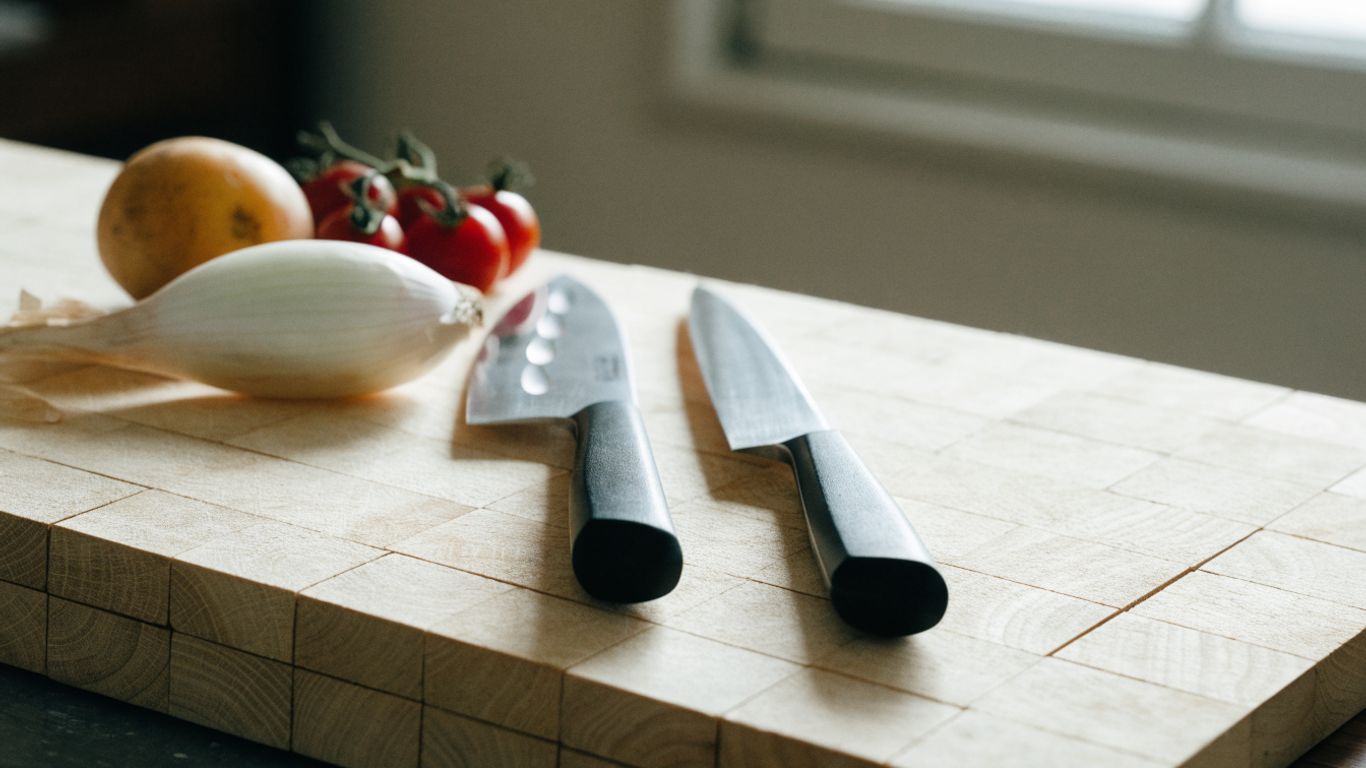
What separates a santoku from a chef knife
A santoku is usually shorter, flatter along the edge, and finished with a rounded, sheepsfoot-style tip; a chef knife is usually longer, more curved, and pointed. Both can handle everyday slicing, chopping, and mincing, so your cutting motion matters more than the label. If you’re weighing santoku vs chef knife for your first or second Japanese knife, start with the shape that suits your usual prep.
Blade shape, length, and weight
Most santoku blades are about 5 to 7 inches long, while many chef knives fall around 8 to 10 inches. Those are common ranges, not rules: makers offer different lengths, profiles, and weights, and the handle and steel also affect how a knife feels. A shorter blade can feel easier to place precisely, while a longer one gives you more edge for broad, continuous cuts.
A quick comparison makes the typical differences easier to picture. Treat the dimensions as starting points when shopping, not as a guarantee of how any particular knife will feel.
| Feature | Santoku | Chef knife |
|---|---|---|
| Common blade length | About 5–7 inches | About 8–10 inches |
| Edge profile | Flatter through much of the edge | More pronounced curve |
| Tip | Rounded, sheepsfoot-style | Narrower and pointed |
| Typical cutting feel | Direct, compact cuts | Longer strokes and rocking cuts |
The profile is a useful clue, but the exact knife matters: a longer santoku or a flatter chef knife may not match the usual pattern. If possible, compare the knives in person and pay attention to the handle as well as the blade.
The santoku’s flatter edge and sheepsfoot tip
A santoku’s comparatively flat edge puts more of the blade in contact with the board during a straight-down cut. Its rounded tip is less suited to piercing or fine tip work than a sharply pointed chef knife, but it can feel steady for routine slicing and chopping. Many santoku blades also have a taller profile, though that varies by model.
The name is often associated with three kinds of kitchen work: vegetables, fish, and meat. In practice, a santoku can be an all-purpose home knife, particularly if your prep is mostly smaller ingredients and controlled cuts. For a related comparison focused on vegetable work, see nakiri and santoku knives.
The chef knife’s curved edge and pointed tip
A chef knife’s curved edge can support a rocking motion, in which the tip stays near the board as the heel rises and falls. The pointed tip is useful for detail work such as starting a cut or trimming around a small area. Its extra length can also help when you are slicing through a larger ingredient in fewer strokes.
These traits do not make every chef knife a rocker or every santoku a straight chopper. Blade curvature differs from one model to another, and your technique can adapt to the knife. For context on another common all-purpose profile, compare gyuto and Western chef knives.
How each knife handles everyday prep
For most home cooking, both knives can cover the basic jobs of slicing, chopping, and mincing. A santoku often feels nimble for compact prep, while a chef knife’s longer, more curved edge can suit larger ingredients and longer strokes. The best match depends on what you cut often and how you move the blade.
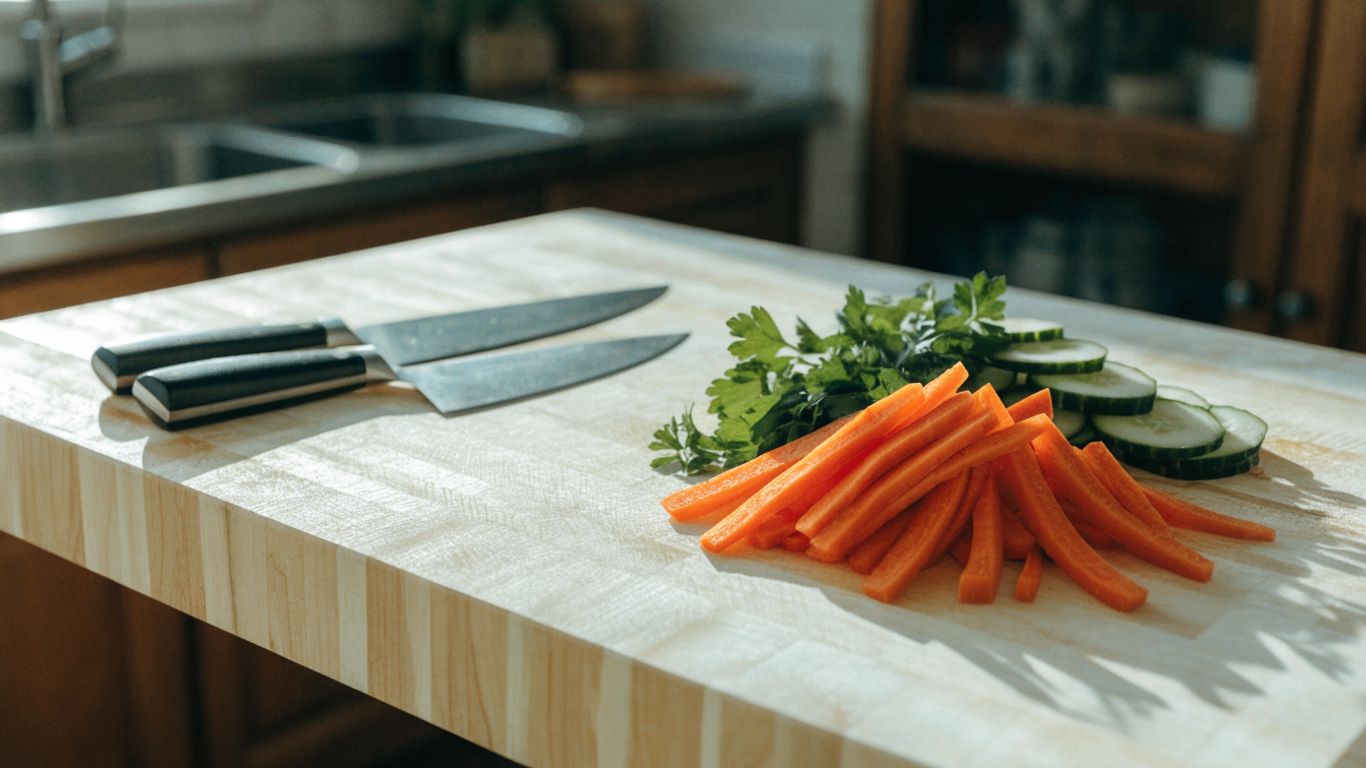
Slicing vegetables and herbs
Either knife can make clean slices through vegetables when its edge is sharp and your motion is controlled. The santoku’s flatter profile can make repeated straight-down cuts feel natural; a chef knife offers a longer edge for drawing through a tomato, cabbage, or other broad ingredient. For herbs, use a comfortable motion that keeps the blade controlled rather than forcing a knife into a style that feels awkward.
A consistent cut also comes from the way you position the food, not only from the knife profile. If you want a step-by-step guide to even pieces, this uniform vegetable dice method covers a simple plank-to-stick-to-cube approach.
Chopping, rocking, and mincing
The shape of the edge affects how easily a knife rocks, but either knife can chop and mince. A flatter santoku generally asks for more lifting and lowering, while a curved chef knife can roll through ingredients when you keep the tip near the surface. For herbs or garlic, choose the motion that gives you control without making the blade skate or bounce.
Use these simple cues to match the cut to the knife rather than trying to make every task look the same:
- For a straight-down chop, let the edge meet the board evenly.
- For a rocking cut, keep the tip controlled and raise the heel in a smooth arc.
- For a long slice, use enough of the blade to complete the cut without sawing.
- For mincing, gather the pieces safely and use a measured, repeatable motion.
These are options, not rules. If a motion feels unstable, switch to a simpler cut and reset your grip and ingredients before continuing.
Trimming meat and handling larger ingredients
Both knives can trim boneless meat and portion everyday ingredients, but neither is meant to replace a specialized knife for every job. A chef knife’s extra length and pointed tip may be helpful when you need a longer cut or more precise tip work. A santoku can manage smaller portions comfortably, though its shorter blade may require more strokes on a large ingredient.
For a thick or unwieldy item, work in manageable sections and keep the knife path clear. Don’t twist the blade in the cut or use it to force through bones; those actions can damage an edge and reduce control.
Match the knife to your cutting style
The main difference you will notice at the board is often how the edge meets the surface. A santoku tends to suit push cuts and straight-down chopping, while a chef knife’s curve can make rocking cuts feel more natural. Neither profile is limited to one technique, so consider the motions you already use comfortably.
Push cutting and straight-down chopping
In a push cut, the blade moves forward and down through the ingredient, then lifts for the next cut. A santoku’s flatter edge can make this motion feel direct because more of the edge can contact the board without much rocking. This is a practical fit if you tend to lift the whole blade between cuts rather than keeping the tip planted.
The result still depends on the knife’s exact curve and your preferred grip. If you are choosing among Japanese profiles, a Japanese knife selection guide can help you compare santoku with options such as gyuto, nakiri, and petty knives.
Rocking cuts and longer strokes
A chef knife’s curved edge provides a natural path for rocking: the tip can stay close to the board as the heel rises and falls. The longer blade can also make a continuous slicing stroke easier on larger ingredients. A santoku can still handle a modest rocking motion, but a very flat profile may feel less fluid for that technique.
Think about the movement you repeat most, rather than the technique you hope to learn someday. If you regularly rock through herbs or mince several ingredients, a more curved edge may feel familiar; if most of your cuts are direct and vertical, a flatter edge may suit your rhythm.
How blade shape affects knuckle clearance
Knuckle clearance is the space between your curled fingers and the board while you hold the ingredient. A taller blade can provide more room for your knuckles, but overall height, handle position, and your hand size all affect the fit. Santoku knives are often fairly tall for their length, though individual designs vary.
Check clearance with a safe grip if you can handle a knife before buying. Keep your fingertips curled back, and avoid judging the fit from blade length alone: a short but tall blade may feel more comfortable than a longer, lower-profile one.
Compare comfort and control
Comfort comes from the whole knife, not from blade type alone. Balance, handle shape, length, and weight all influence how steady it feels during repeated cuts. When comparing santoku and chef knife options, a few minutes of careful handling can tell you more than a name on the box.
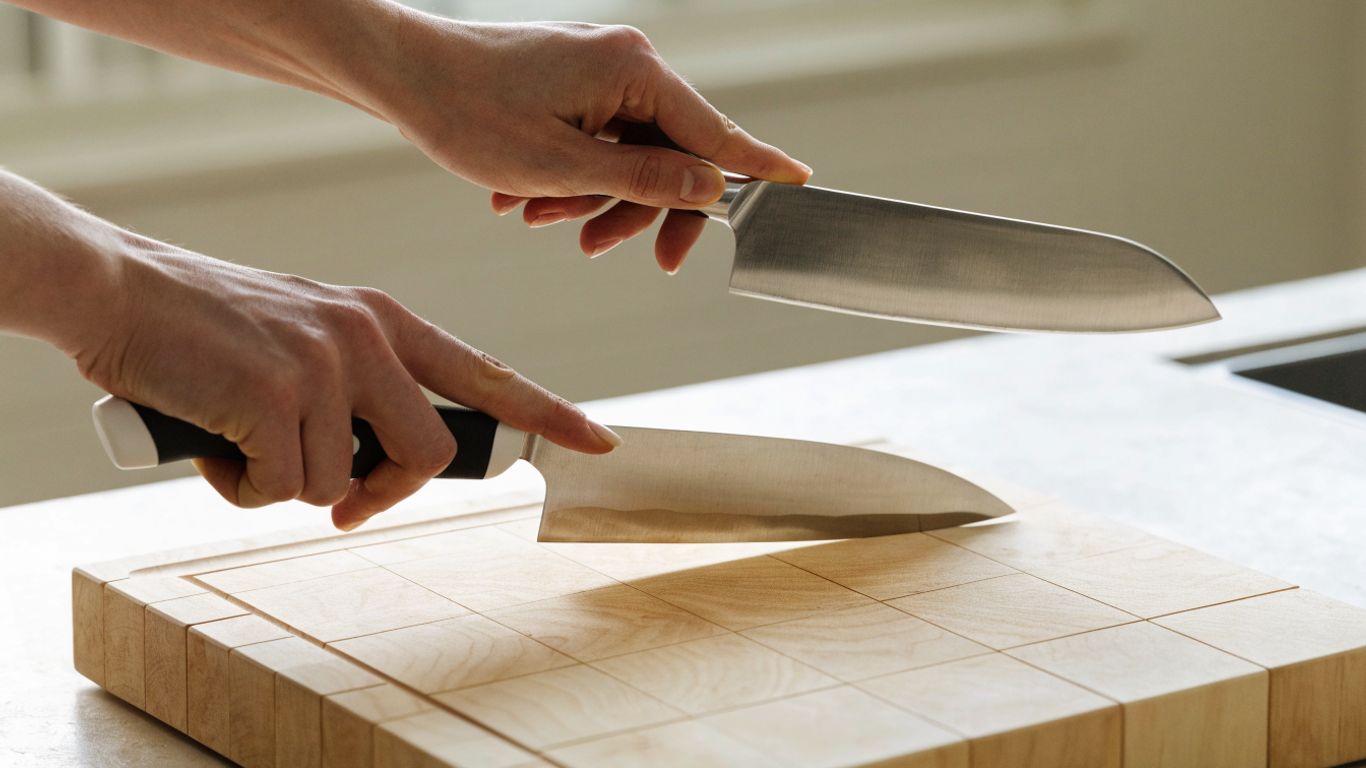
Balance and overall weight
A lighter knife can feel quick to reposition, while a heavier one may feel more substantial in the hand. Neither quality guarantees better control: balance shifts with the blade, handle, and construction, and what feels steady to one cook may feel tiring to another. Compare the whole knife rather than assuming a santoku is always lighter or a chef knife is always heavier.
If you shop in person, hold each knife in your usual grip and make a few careful, controlled movements in the air. Look for a knife that feels predictable rather than one that requires you to adjust your wrist to keep the blade aligned.
Grip, hand size, and blade length
The handle should feel secure without forcing your fingers into a cramped position. A shorter blade can feel manageable in a small prep area, but handle thickness and shape matter just as much as blade length. With either knife, make sure your hand can keep a stable grip without your fingers crowding the cutting edge.
A longer chef knife may be useful for broad strokes, but it can feel like extra blade if you mainly work with small ingredients. Conversely, a compact santoku may feel limiting if your usual prep includes large vegetables or long slicing cuts. The right fit is the one you can guide comfortably through the work you actually do.
When a lighter knife feels easier to use
If you make many short cuts in a row, a knife that feels easy to lift and reposition may reduce the sense of effort. That does not mean the lightest option is automatically the safest or most comfortable; a knife that feels too light or poorly balanced can be harder to guide. Try to judge how the knife moves through a normal range of motions.
Pay attention to fatigue as well as first impressions. A handle that feels good for a few seconds may become less comfortable during a longer prep session, so consider the shape of your hand and how long you typically cook.
Consider sharpness, care, and durability
Blade profile does not tell you everything about performance or upkeep. Steel, edge geometry, heat treatment, and the maker’s construction all affect how a particular knife behaves. Before buying, check the maker’s specifications and care instructions rather than assuming every santoku or chef knife needs the same attention.
Differences in blade steel and edge angles
Santoku and chef knives are made in a range of steels and edge geometries, so the category name alone cannot predict sharpness or edge retention. A thinner or harder edge may cut with less resistance, but it can also be less tolerant of careless contact. Check the maker’s published information for the specific model, including its steel and recommended care.
Price varies widely with materials, construction, and maker. Set a budget around the features you value, and do not assume a more expensive knife will suit your hand or cutting style better. A clear return policy can be useful if the handle or balance proves uncomfortable.
Sharpening and honing needs
Any knife will eventually need edge maintenance, but the interval depends on its steel, use, and how it is treated. Follow the maker’s guidance for the specific knife, especially if it has a delicate edge or a particular sharpening recommendation. Avoid using the blade for tasks it was not designed for, such as prying or cutting through bone.
A common buying mistake is to focus only on how sharp a knife feels when new. Consider whether you can access suitable maintenance for its steel and edge, and whether you are comfortable following the maker’s care instructions over time.
Using a suitable cutting board
Use a stable cutting surface that is intended for knife work, and avoid cutting on hard materials such as glass, stone, or ceramic. Very hard surfaces can be unforgiving to an edge, particularly if you make repeated forceful contact. The main point is simple: a suitable surface helps you keep cuts controlled and avoid unnecessary impact on the blade.
Keep the knife’s intended use in mind, too. A sharp kitchen knife is for cutting food, not scraping ingredients with its edge or levering pieces apart; turn the blade over to move chopped ingredients when needed.
Choose the knife that fits how you cook
There is no universal winner in the santoku vs chef knife choice. A santoku is a sensible starting point if you prefer compact, direct cuts, while a chef knife may fit better if you often use a rocking motion or need extra blade length. Your budget, hand comfort, and access to care matter alongside the shape.
Pick a santoku for compact, precise prep
A santoku may suit you if most of your cooking involves vegetables, herbs, and modest portions, and you prefer a shorter blade with a relatively flat edge. Its compact length can feel easy to manage in a small workspace, while the taller profile may offer useful knuckle clearance. Check the actual knife before buying, since models differ in height, weight, and handle shape.
Best for: cooks who favor push cuts, straight-down chopping, and controlled everyday prep. If you rely on frequent rocking cuts or routinely slice large ingredients, compare the blade length and curve carefully before deciding.
Pick a chef knife for varied tasks and rocking cuts
A chef knife may be the more comfortable choice if you already rock through ingredients or want a longer blade for broad slicing. Its pointed tip can help with detail work, and the curved edge suits a rolling motion. These are useful traits, not a promise that every chef knife will fit every hand.
Best for: cooks who want a versatile all-purpose profile, prefer longer strokes, or routinely work with larger ingredients. Consider a gyuto as another Japanese-style all-purpose option, and compare its length and profile with the chef knife you have in mind.
Decide whether one knife or both makes sense
If you are buying one knife, choose the profile that matches your most common tasks and feels comfortable in your grip. If you already own a reliable chef knife, a santoku can add a shorter, flatter option for compact prep; the reverse is true if you want a longer blade for rocking and broad slicing. Buying both is useful only if you will reach for each one.
This comparison is based on common blade profiles and typical size ranges, not hands-on testing of specific models. Before you buy, check the maker’s specifications, try the grip when possible, and make sure the knife’s care requirements fit your routine.
Frequently Asked Questions
Is a santoku better than a chef knife for vegetables?
Either can handle vegetable prep well. A santoku’s flatter edge may feel natural for straight-down cuts, while a chef knife’s curve can suit rocking cuts and longer strokes.
Can you rock a santoku knife?
Yes, though how easily it rocks depends on the blade’s curvature. A flatter santoku may feel less fluid for rocking than a more curved chef knife.
Is a chef knife longer than a santoku?
Often, yes. Many chef knives are about 8 to 10 inches, while many santoku knives are about 5 to 7 inches, but the exact dimensions vary by model.
What does the santoku’s rounded tip do?
A rounded, sheepsfoot-style tip gives the santoku a different profile from the pointed tip common on chef knives. It is less suited to piercing or fine tip work, so consider your usual tasks before choosing.
Which knife is easier for a beginner to control?
That depends on your hand, grip, and cutting motion. A shorter santoku may feel manageable to some cooks, while others prefer the balance and longer edge of a chef knife.
Can a santoku replace a chef knife?
For many everyday kitchen tasks, a santoku can serve as your main knife. If you often use a rocking motion, need a longer blade, or value a pointed tip, a chef knife may suit you better.
What should you check before buying either knife?
Compare blade length, edge shape, weight, handle comfort, steel, and the maker’s care guidance. If possible, hold the knife in your usual grip before committing.
How this guide was put together
The End Grain Cutting Board Guide team writes and fact-checks every guide on End Grain Cutting Board Guide. Comparisons are based on maker specifications, published standards and food-safety guidance from sources such as the USDA, and each guide is reviewed and updated when specs or prices change. More about us.