END-GRAIN GUIDES
What Is a Santoku Knife? Shape, Uses and Sizes
Learn what a santoku knife is, how its blade works, common sizes, everyday uses, and how it compares with a chef’s knife.
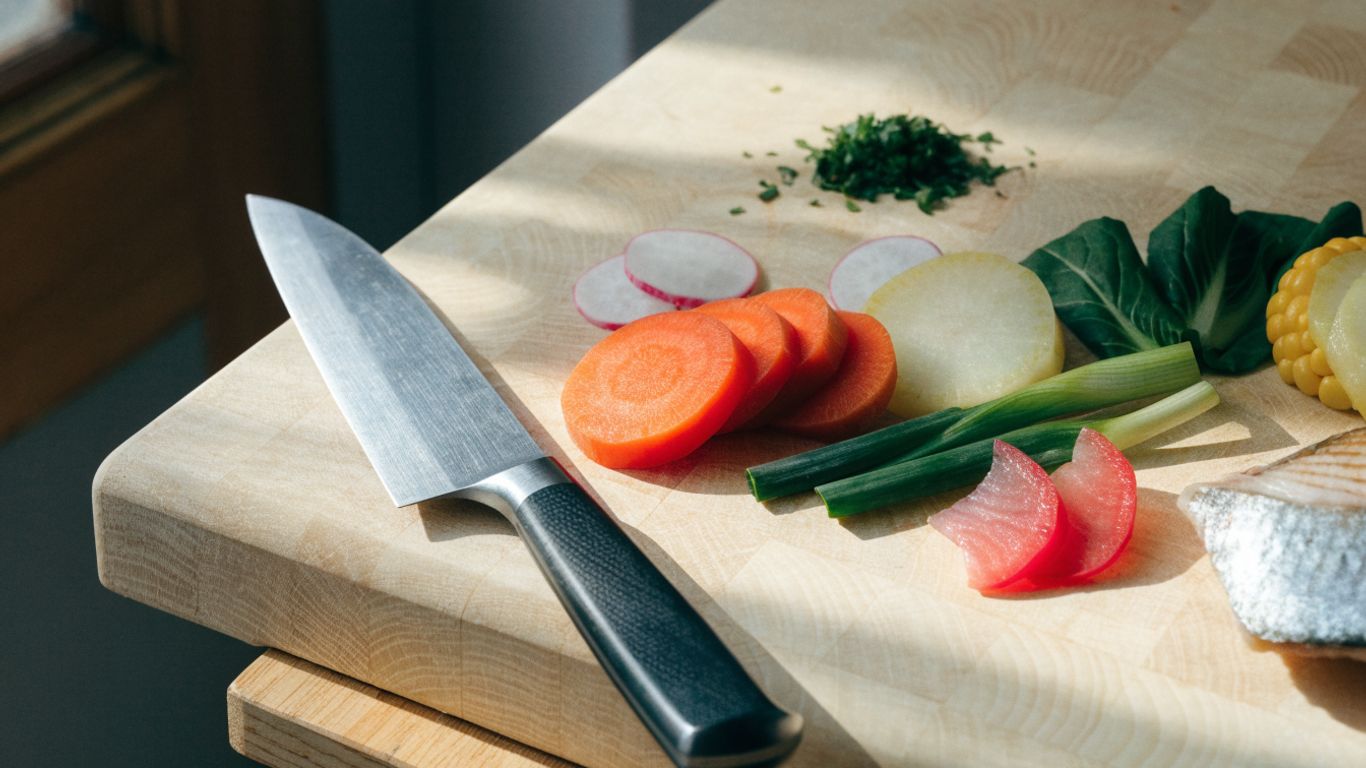
What a santoku knife is
A santoku knife is a Japanese-style all-purpose kitchen knife with a relatively short, broad blade and a gently curved or nearly flat edge. Its name is commonly translated as “three virtues,” referring to its use for vegetables, meat, and fish. If you’re choosing your first Japanese knife, a santoku is a practical option when you want one blade for much of your everyday prep.
The meaning behind the name
The “three virtues” are usually understood as the three broad categories of ingredients the knife can handle: vegetables, meat, and fish. The name describes versatility, not a special cutting motion or a fixed set of blade measurements.
How it differs from other Japanese knives
A santoku is shorter and often has a flatter edge than a gyuto, the Japanese all-purpose knife with a profile closer to a Western chef’s knife. A nakiri has a straight, rectangular blade designed around vegetable work, while a santoku combines a broad blade with a tip that can handle a wider mix of tasks. For another perspective on the vegetable-focused alternative, see this nakiri and santoku comparison.
What to expect from a typical santoku
Most santoku knives have a blade around 5 to 7 inches long, with a spine that feels broad enough to guide ingredients and a tip that curves or angles down toward the edge. Details vary by maker, so two knives with the same length can still feel quite different in hand. Look for a balance of reach, control, and comfortable grip rather than assuming every santoku has the same profile.
Santoku blade shape and features
A santoku’s broad blade and relatively level edge suit controlled cuts that move down and forward through food. Its profile usually has less pronounced belly than a typical chef’s knife, though the exact curve depends on the model. The shape helps explain why santoku knives feel at home in compact, everyday prep.
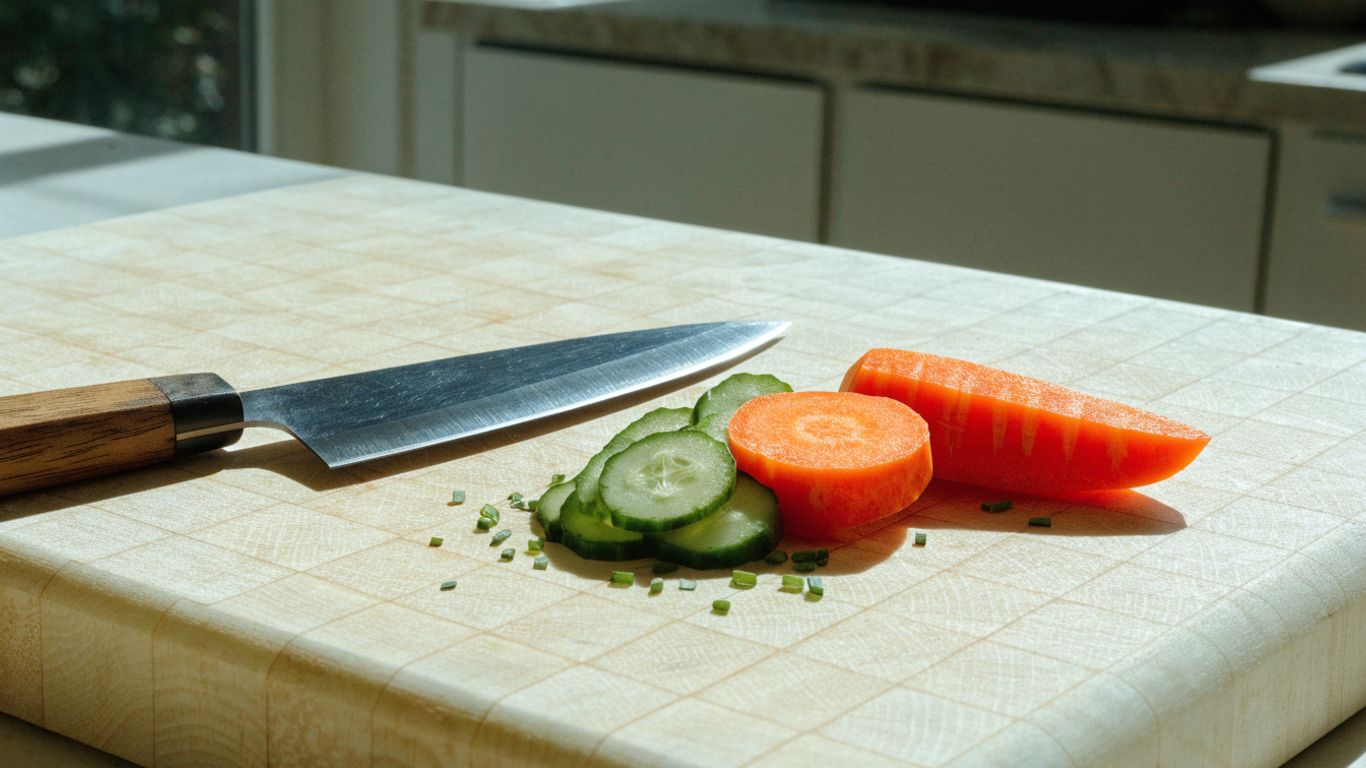
The broad blade and its flatter edge
The blade’s height gives your knuckles room above the cutting surface and provides a broad side that can help guide food after a cut. A flatter edge encourages a downward or forward push-cut rather than a deep rocking arc. That difference is noticeable when you’re making repeated slices or small, even cuts.
The rounded or angled tip
Santoku tips commonly curve down toward the edge or meet it at a more defined angle. Either shape can make the front of the knife useful for detailed cuts, but it is not as sharply pointed as some other Japanese knife profiles. Treat the tip as a cutting edge, not a lever for prying or twisting.
Granton dimples and other optional details
Some santoku blades have shallow hollows, often called Granton dimples, along the sides. They may help reduce food sticking to the blade, but they are optional and do not define the knife type. Other differences, such as handle shape, blade finish, and steel, also affect feel, so consider the whole knife rather than one decorative feature.
What a santoku knife is used for
A santoku is designed for the common mix of cutting jobs in a home kitchen, especially slicing and chopping vegetables, herbs, boneless meat, and fish. Its broad blade and compact length can feel manageable when you’re working on a smaller counter or cutting board. It is versatile, but it is not a substitute for every specialized blade.
Slicing vegetables and herbs
The flatter edge works well for slicing onions, carrots, cucumbers, and other vegetables with a controlled downward motion. You can also use it to chop herbs, though a gentle forward movement is usually more comfortable than trying to rock the entire blade. For consistent pieces, a steady grip and an even cutting rhythm matter as much as the knife profile; this guide to uniform vegetable dice explains the basic plank-to-stick-to-cube approach.
Cutting boneless meat and fish
A santoku can slice boneless meat and portion fish for ordinary cooking, provided the blade is long enough for the piece you’re cutting. Use smooth, deliberate strokes rather than forcing the knife through a tough or oversized item. For long, clean slices through a larger piece, a longer blade may give you more reach.
Tasks that call for a different blade
A santoku’s general-purpose shape has limits. If the task depends on a specialized blade profile, another Japanese knife may be easier to control. Common examples include:
- A nakiri for repeated vegetable slicing with its straight edge.
- A petty knife for small ingredients and close trimming.
- A yanagiba for long, draw-cut slices of boneless fish.
These are useful alternatives, not a list of tools you must own. If your cooking mostly involves everyday produce and boneless proteins, a santoku may cover a broad share of your prep; for a narrow, specialized job, choose the blade built around it.
Common santoku knife sizes
Santoku knives are often sold with blades from about 5 to 7 inches long, with 6.5 inches (roughly 165 mm) a common middle ground. A shorter blade can feel nimble in a tight workspace, while a longer one gives you more cutting edge for larger ingredients. Your hand size, prep habits, and available counter space all matter more than the number alone.
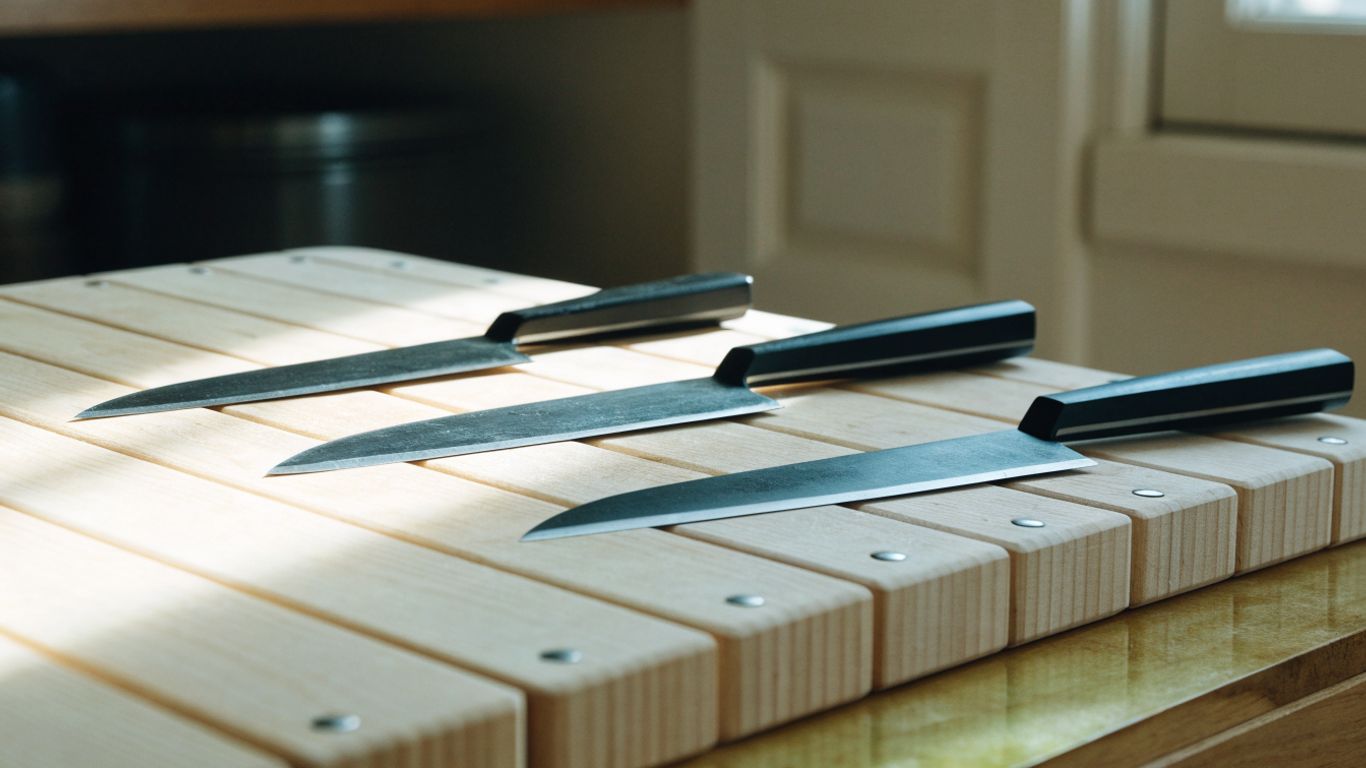
How blade length is measured
Blade length is measured from the heel, where the cutting edge meets the handle, to the tip. Makers may list the measurement in inches or millimeters, and small differences in where a measurement begins can affect comparisons. Check the listed blade length and the knife’s overall dimensions before buying, especially if you have limited drawer or counter space.
Choosing between 5-, 6.5- and 7-inch blades
These common lengths offer a useful starting point, but the numbers describe reach rather than overall comfort. The table compares the typical trade-offs; exact proportions and feel vary between knives.
| Blade length | Approximate metric length | What it tends to suit |
|---|---|---|
| 5 inches | 127 mm | Compact prep and a smaller workspace |
| 6.5 inches | 165 mm | A balanced size for varied everyday tasks |
| 7 inches | 178 mm | More reach for larger vegetables and portions |
If you are unsure, a middle-length blade is a reasonable place to start because it avoids the most compact and most extended ends of the range. Still, the handle and balance can change how a knife feels, so consider trying a similar length in person when possible.
Matching knife size to hand and kitchen space
A comfortable knife should let you guide the blade without crowding your fingers or reaching awkwardly across the ingredient. In a small kitchen, a shorter santoku can be easier to maneuver, while a longer one may suit frequent batch prep. For help comparing santoku and chef’s-knife profiles by length, cutting style, and handling, read this everyday knife comparison.
Santoku vs. chef’s knife
A santoku is typically shorter, broader, and flatter along the edge than a chef’s knife, whose curved profile supports a more pronounced rocking motion. Neither shape is automatically better; the useful choice depends on how you cut and what you prepare most often. If you already own a chef’s knife, compare the two by their movement and reach rather than by their labels.
Comparing blade shape and cutting motion
The santoku’s flatter edge tends to stay in contact with the cutting surface over more of its length during a push cut. A chef’s knife usually has a more pronounced curve from heel to tip, which allows the blade to roll through ingredients. The differences are gradual, and individual knives may sit between these familiar profiles.
Which knife suits rocking or push-cutting
If you naturally lift and roll the tip while chopping, a more curved profile may feel familiar. If you prefer moving the edge down and forward through food, the santoku’s flatter profile may feel more direct. Try to keep the motion controlled; forcing a rocking action onto a blade with a flatter edge can feel awkward, while a push cut can work with either knife.
When one knife can cover most everyday prep
Either knife can handle a wide range of routine kitchen jobs, from slicing vegetables to cutting boneless proteins. A santoku may be a comfortable single-knife choice if its shorter reach and push-cut feel match your habits; a chef’s knife may suit you better if you prefer a longer blade and a rolling motion. This comparison of gyuto and chef’s knives can help clarify how blade profile and cutting style affect the choice.
Choosing and using a santoku knife
When choosing a santoku, focus on blade length, handle comfort, and the cutting motion you use most. The price of a knife varies with its materials and construction, so check maker specifications and what is included before you buy. You do not need every optional feature; a straightforward blade that feels controlled in your hand is a sound starting point.
Picking a blade style and handle that feel comfortable
Hold the knife if you can, using the grip you normally use while cutting, and notice whether your hand feels cramped or strained. Check that the blade’s height gives your knuckles enough clearance and that the handle sits securely without forcing your wrist into an odd angle. Comfort over ornament is a useful rule: surface patterns and dimples matter less than a shape you can guide steadily.
Using a controlled push-cutting motion
Set the ingredient securely, keep your guiding hand curled back, and move the blade down and slightly forward through the food. A santoku’s flatter profile can make that motion feel natural, but there is no need to rush or press harder than the cut requires. If you want more options for matching a Japanese knife to your workspace and cooking habits, this Japanese knife picker offers a practical starting point.
Protecting the edge with proper storage and care
Use the knife for cutting rather than prying, twisting, or striking hard materials, and follow the maker’s instructions for cleaning and storage. A santoku is intended for ordinary kitchen prep, not bones or frozen food, and forcing it through either can damage the edge. Before buying, check the maker’s care guidance and choose a knife whose intended use fits your routine.
Frequently Asked Questions
What does santoku mean?
Santoku is commonly translated as “three virtues,” referring to the knife’s versatility with vegetables, meat, and fish. It describes the range of tasks, not a required blade size.
What is a santoku knife used for?
It is commonly used for slicing and chopping vegetables, herbs, boneless meat, and fish. Its broad blade and relatively flat edge suit controlled everyday cuts.
What size santoku knife should I buy?
Many home cooks consider blades around 5 to 7 inches, with 6.5 inches a common middle option. Choose based on your hand, workspace, and the size of ingredients you usually prepare.
Is a santoku knife better than a chef’s knife?
Neither is better for everyone. A santoku tends to suit a flatter push-cutting motion, while a more curved chef’s knife can feel more natural for rocking cuts.
Can a santoku knife cut meat and fish?
Yes, it can handle boneless meat and fish for everyday cooking. For specialized tasks or long slices through large portions, another blade may offer more suitable reach or control.
What is the difference between a santoku and a nakiri?
A santoku is a general-purpose knife with a tip and a profile suited to several ingredient types. A nakiri has a straighter, more rectangular blade focused on vegetable preparation.
Do all santoku knives have dimples?
No. Dimples are an optional blade detail, not a defining feature of a santoku. Knives without them can still have the characteristic broad blade and general-purpose profile.
How this guide was put together
The End Grain Cutting Board Guide team writes and fact-checks every guide on End Grain Cutting Board Guide. Comparisons are based on maker specifications, published standards and food-safety guidance from sources such as the USDA, and each guide is reviewed and updated when specs or prices change. More about us.