END-GRAIN GUIDES
The Two-Minute Board Reset Between Prep Tasks
How to reset a cutting board between prep tasks: the quick sequence, when a scrape and wipe is enough, and when the board has to go to the sink.
The short answer
Between prep tasks, scrape the board, dry-wipe it, damp-wipe it if needed, and dry it right away. That takes under two minutes and covers most transitions. Save hot water and soap for strong aromatics, sticky foods, and staining foods. After raw meat, poultry, fish, or eggs, always wash and sanitize.
Home cooks tend to do one of two things between prep tasks: nothing at all, or a full wash at the sink.
Neither is right. Doing nothing means garlic ends up in your fruit salad. A full wash five times in one session means a soaking wet board and a lot of standing around.
Many cooks use a third option between full washes, and it takes about two minutes.
What is the reset, in order?
- Scrape. Bench scraper, or the spine of your knife, never the edge. Push everything off in one pass into a bowl or the bin.
- Dry-wipe. A dry towel across the surface picks up what the scrape left behind.
- Damp-wipe if needed. Hot water on a cloth, wrung out properly. Damp, not wet.
- Dry immediately. The board should be dry to the touch before the next thing lands on it.
- Flip if warranted. A two-sided board gives you a clean surface with no cleaning at all.
That's it. Under two minutes, and the board stays dry and usable all session.
The dry step matters more than people think. Prep on a damp board and everything sticks, the board slides more, and you're slowly working moisture into the wood over an hour.
When is a scrape enough?
Most of the time. If you're moving between things that are going into the same pot, you don't need to sterilize between them.
- Onion, then carrot, then celery, scrape and carry on
- Vegetables, then herbs, a scrape, and the board is fine
- Bread, then cheese, a dry wipe if anything
Perfectly clean between every vegetable is not a standard most busy kitchens hold, and it wastes time you could spend cooking.
When do you need water?
Some transitions genuinely need more than a scrape.
Strong aromatics before delicate food. Garlic, onion, chilies and fish leave oils behind that a dry scrape won't lift. Going from garlic to strawberries without a wash produces a memorable and unwelcome result.
Anything sticky or sugary. Honey, dates, syrups. Scraping just smears it around.
Staining ingredients. Beets, turmeric, berries. Get to these quickly or the stain sets, not a safety problem, but a cosmetic one you'll live with.
For all of these: hot water, a drop of soap, cloth, rinse, dry immediately. Still not a soak.
When does the board have to go to the sink?
One category, and it isn't negotiable.
Raw meat, poultry, fish and eggs. After any of these, the board gets a proper wash, hot water, soap, then sanitize. A scrape and a wipe is not adequate, and this is the transition where cross-contamination actually causes illness.
To sanitize: one tablespoon of unscented bleach per gallon of water, wiped on and left to stand for several minutes before rinsing. Or white vinegar and hydrogen peroxide applied as separate wipes, never mixed in the same bottle. Rinse, dry with a towel, then stand it on edge.
The better plan is to not need this mid-session at all. Which brings us to sequencing.
Which reset does each transition need?
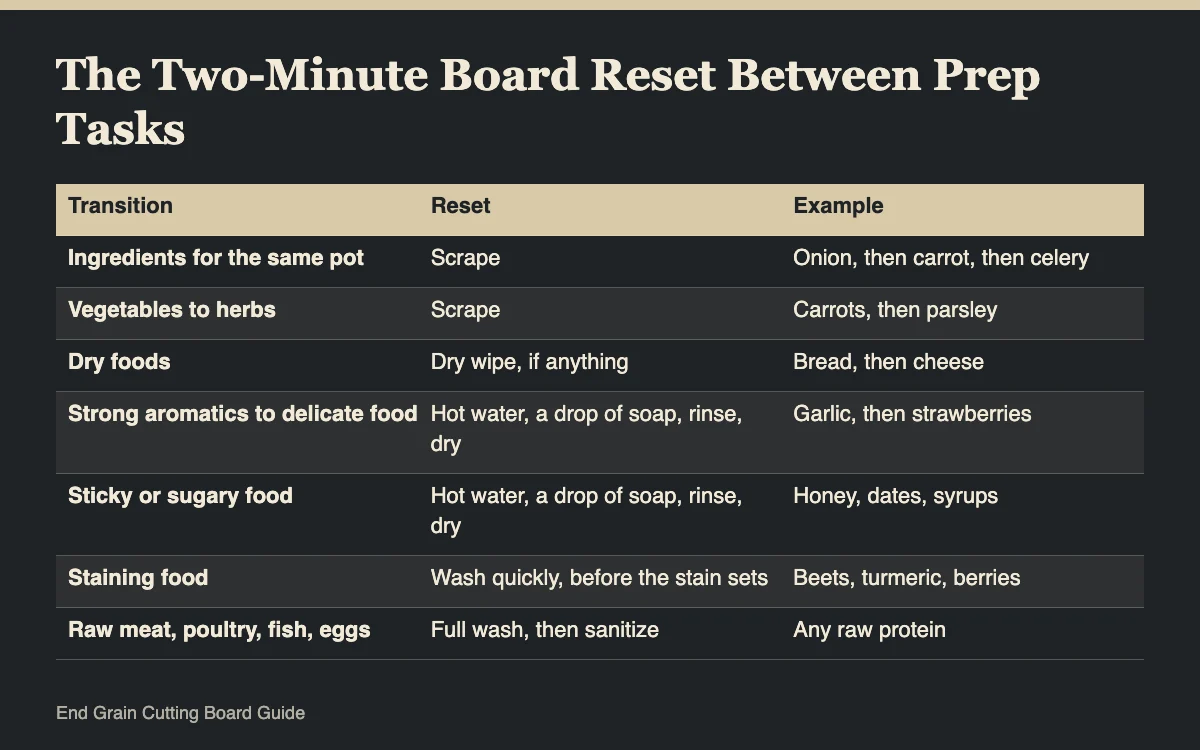
Here is the whole system in one place.
| Transition | Reset | Example |
|---|---|---|
| Ingredients for the same pot | Scrape | Onion, then carrot, then celery |
| Vegetables to herbs | Scrape | Carrots, then parsley |
| Dry foods | Dry wipe, if anything | Bread, then cheese |
| Strong aromatics to delicate food | Hot water, a drop of soap, rinse, dry | Garlic, then strawberries |
| Sticky or sugary food | Hot water, a drop of soap, rinse, dry | Honey, dates, syrups |
| Staining food | Wash quickly, before the stain sets | Beets, turmeric, berries |
| Raw meat, poultry, fish, eggs | Full wash, then sanitize | Any raw protein |
Why does keeping the board dry matter?
Wood takes on water and gives it back as it dries. When one face gets wetter than the other, the board can cup. Repeated soaking can also open small cracks and stress glue joints over time.
Moisture is also what bacteria need to grow. A board that dries quickly between uses gives them less of a chance. That is why the dry step is in every version of the reset.
How do you get rid of garlic or onion smells?
Smells are a comfort problem, not a safety one. A common fix is to sprinkle coarse salt on the board, scrub it with half a lemon, then rinse and dry.
A paste of baking soda and a little water works too. Rub it in, rinse it off, and dry the board right away. If the board starts to look pale or dry afterward, oil it.
How do you sequence prep so you barely have to reset?
The real professional trick isn't fast cleaning. It's ordering the work so cleaning is rarely necessary.
Work cleanest to dirtiest. Bread and cheese, then vegetables, then aromatics, then raw meat last. Do it in that order and most of your resets are a scrape.
Do all of one thing at once. Dice every onion the recipe needs in one go, not one now and one in ten minutes. Fewer transitions, fewer resets.
Get finished prep off the board. Small bowls, a sheet pan, anything. A board that stays clear stays usable, and you stop feeling like you need a bigger board.
Keep a scrap bowl within reach. Peelings and ends go straight in rather than piling up at the back of the board.
Use a separate board for raw meat. A cheap plastic board that goes in the dishwasher solves the hardest transition entirely. This works well even if your main board is wood.
Sequence well and a full dinner's prep might need one scrape between stages and one real wash at the end.
What does the station around the board need?
The reset is faster when the station is set up for it.
- Damp towel under the board. Stops it sliding, and it's already there when you need to wipe.
- Dry towel to the side. For the drying step. Keep it dry, a soggy towel just moves water around.
- Bench scraper within reach. A few dollars, and it moves prep off the board far better than a knife.
- Scrap bowl. Anything will do.
- Board on edge when you're done. Not flat on the counter. Both faces need the same air or the board cups toward the dry side.
The Bottom Line
Scrape, dry-wipe, damp-wipe if needed, dry immediately. That handles most transitions in under two minutes and keeps the board dry, which is what keeps it flat.
Save the full wash for strong aromatics, sticky messes and anything raw, and sequence your prep cleanest to dirtiest so you need it less often.
A board that works well for this is thick enough to stay put while you scrape, and finished well enough that a damp wipe lifts residue instead of soaking in. That's what a thick end-grain maple board is built for, if you're putting a station together.
Related: A resealed surface makes the damp wipe work better, so keep this step-by-step oiling guide for maple boards handy for when the board starts looking dry.
Before you start
- What you need: A bench scraper (about $8 to $15), a damp cloth, a dry towel and a scrap bowl. With a Japanese knife this matters more: scraping food off the board with the edge rolls or chips thin, hard steel, so use the spine or the scraper.
- Time: A reset between produce tasks takes 1 to 2 minutes. After raw meat, poultry or fish, plan on a full wash with hot soapy water, rinse and dry, which takes about 3 to 5 minutes.
- Alternatives: Keep a second board for raw proteins so you can skip the full wash mid-prep. Flipping the board works between produce tasks only if both sides are flat and clean.
- Common mistakes: Wiping raw-meat juice with a cloth and then moving straight to salad, leaving wet scraps that make the next ingredient slide, and letting garlic or onion juice sit before cutting fruit.
Sources: USDA FSIS: Cutting Boards and Food Safety.
Best for
- Scrape only: moving between ingredients that go into the same pot.
- Dry wipe: bread, cheese, and other dry foods.
- Hot water and a drop of soap: strong aromatics, sticky foods, and staining foods.
- Full wash and sanitize: after raw meat, poultry, fish, and eggs.
- Two-sided boards: a quick flip when you need a clean face mid-session.
Frequently Asked Questions
How do you clean a cutting board between uses?
Scrape it, dry-wipe it, damp-wipe it if needed, and dry it right away. That handles most transitions in under two minutes.
Do you need to wash the board between every vegetable?
No. If the ingredients are going into the same pot, a scrape is enough.
What should you do after cutting raw meat on a board?
Wash it with hot water and soap, sanitize it, rinse, and dry it with a towel. Then stand it on edge.
How do you sanitize a wooden cutting board?
Wipe on one tablespoon of unscented bleach per gallon of water, leave it a minute, then rinse. White vinegar and hydrogen peroxide also work as separate wipes, never mixed in the same bottle.
Should you soak a wooden cutting board?
No. Even the full wash is quick. Soaking puts too much water into the wood.
Why stand the board on edge to dry?
Both faces get the same air. A board left flat dries unevenly and can cup toward the dry side.
What should you do next?
- Put a bench scraper, a dry towel, and a scrap bowl at your station.
- Plan your next prep session from cleanest to dirtiest.
- Keep a separate board for raw meat.
- See the same ideas applied to a full menu in mise en place for a dinner party.
- If you share the kitchen, read an end grain board for a two-cook kitchen.
SEE AN EXAMPLE
How this guide was put together
The End Grain Cutting Board Guide team writes and fact-checks every guide on End Grain Cutting Board Guide. Comparisons are based on maker specifications, published standards and food-safety guidance from sources such as the USDA, and each guide is reviewed and updated when specs or prices change. More about us.