END-GRAIN GUIDES
Knife Skills for a More Uniform Dice
Use a stable board, a sharp edge, and a repeatable cutting sequence to make vegetables cook more evenly.
The short answer
To get a uniform dice, put every vegetable through the same sequence: a stable shape, even planks, sticks, then cubes. A board that does not slide, a sharp knife, and a claw grip keep each cut controlled.
Uniform pieces cook at the same rate and make every bite more balanced. Start by trimming the vegetable into a stable shape, create planks, stack them carefully, then cut across into a dice. Keep fingertips curled and guide the knife with the knuckles of your non-cutting hand.
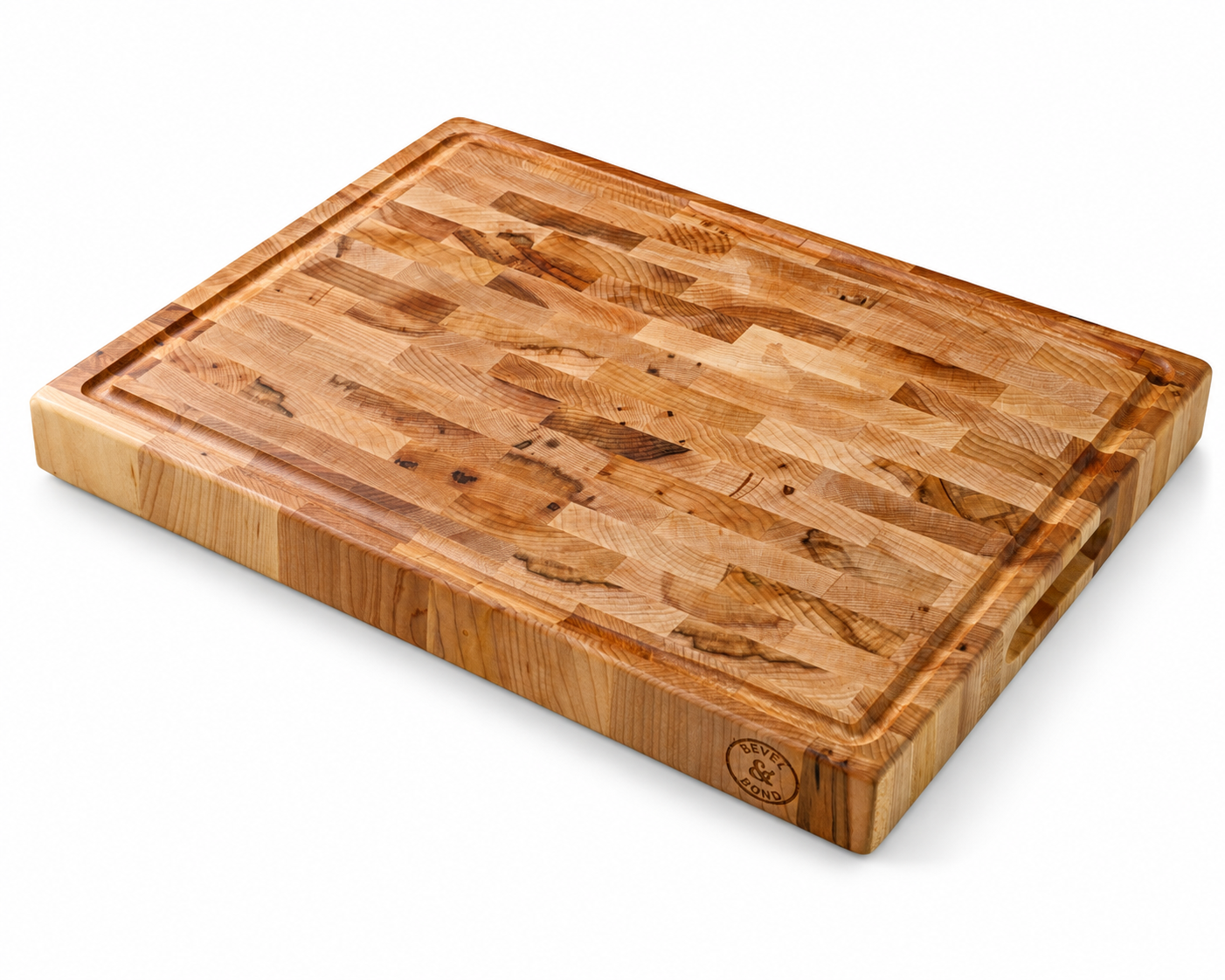
The board should not slide. Place a damp towel beneath it and keep the knife edge sharp; a dull knife needs pressure and is harder to control. Move finished ingredients with a scraper, not the sharp edge of the knife.
Practice with onions, carrots, and potatoes before attempting delicate herbs. For a complete station layout, read this station sizing guide for maple boards and see these hard maple board options.
Why does a uniform dice matter?
Size controls cooking time. Small pieces cook through faster than large ones. A pan of mixed sizes gives you some pieces that are soft and others that are still firm.
Even pieces also brown more evenly. They look tidier in a soup or salad, and every spoonful tastes about the same.
What are the standard dice sizes?
Cooking schools use a few classic names for cube sizes. You do not need to measure every piece. The names just give you a target.
| Cut | Approximate size | Common uses |
|---|---|---|
| Brunoise | 1/8 inch (about 3 mm) cubes | Garnishes, sauces, fine textures |
| Small dice | 1/4 inch (about 6 mm) cubes | Salsas, quick sautés, soups |
| Medium dice | 1/2 inch (about 12 mm) cubes | Soups, stews, hashes |
| Large dice | 3/4 inch (about 2 cm) cubes | Roasting, long braises |
The thickness of your first planks sets the size of the final cube. Cut 1/2 inch planks and you are on the way to a medium dice.
How should you hold the knife and your guide hand?
Use a pinch grip. Pinch the blade just in front of the handle with your thumb and the side of your index finger, and wrap your other fingers around the handle. This gives you more control than holding the handle alone.
Your guide hand makes a claw. Tuck your fingertips under and let your knuckles rest against the flat of the blade. Move that hand back in small, even steps. The distance you move sets the width of each cut.
How do you dice an onion evenly?
An onion is built in layers, so it needs a slightly different sequence. Cut off the stem end, halve the onion through the root, and peel it. Lay one half flat side down.
Make vertical cuts toward the root, but stop short of it. The root holds the layers together. Then slice across those cuts. The closer your cuts, the smaller the dice.
How do you dice round vegetables like carrots and potatoes?
Round vegetables roll, and a rolling vegetable is hard to cut safely. Slice a thin strip off one side so it sits flat. Then square off the other sides.
Cut the block into planks as thick as your target dice. Stack two or three planks, cut them into sticks, then cut across into cubes. Cut long carrots into shorter lengths first. Save the trimmings for stock.
Cut potatoes darken when exposed to air. If you are not cooking them right away, hold the diced pieces in cold water.
Before you start
- Which knife: An 8 to 9.5 inch (210 to 240 mm) gyuto or chef's knife covers onions, carrots and peppers. A shorter petty knife (120 to 150 mm) is easier for shallots and garlic. A santoku's flatter profile suits push cuts but is less suited to rocking.
- Practice time: Plan on dicing two or three onions a week for a few weeks before a medium dice looks even without thinking about it. Speed comes after consistency.
- Cost of practice: Onions, carrots and potatoes are the cheapest practice vegetables, and the trim goes into stock.
- Alternatives: A vegetable chopper with a dicing grid gives uniform cubes for soft vegetables, and a food processor works when looks do not matter. Neither gives the clean cut of a sharp knife.
- Common mistakes: Uneven first planks (they set the final size), a dull edge that crushes rather than slices, curling the guide-hand fingertips out instead of under, and cutting all the way through the root of an onion so it falls apart.
Best for
- Brunoise: garnishes and sauces where you want a fine texture.
- Small dice: salsas, quick sautés, and soups.
- Medium dice: soups, stews, and hashes.
- Large dice: roasting and long braises.
- Practice: onions, carrots, and potatoes, before you move on to delicate herbs.
Frequently Asked Questions
Why do my diced vegetables cook unevenly?
Pieces of different sizes cook at different rates. Cut planks of the same thickness first, and the sticks and cubes that follow will match more closely.
What grip keeps my fingers safe while dicing?
Curl the fingertips of your guide hand under and guide the knife with your knuckles. The blade rests against your knuckles, not your fingertips.
How do I stop my cutting board from sliding?
Place a damp towel under the board. A board that stays put lets you focus on the knife.
Should I use the knife edge to move diced food?
No. Use a bench scraper, or turn the knife over and use the spine. Scraping with the edge dulls it quickly.
Is a sharp knife safer for dicing?
Yes. A dull knife needs more pressure and is harder to control, so it is more likely to slip.
What should I practice on first?
Start with onions, carrots, and potatoes. They are firm, cheap, and forgiving. Move on to delicate herbs once your cuts are consistent.
What should you do next?
- Sharpen or hone your knife before your next prep session.
- Set a damp towel under your board.
- Pick one size, such as a 1/2 inch medium dice, and practice it on a carrot until the pieces match.
- Use the same plank, stick, and cube sequence on fresh ginger.
- Compare blade shapes for vegetable work in nakiri vs santoku.
How this guide was put together
The End Grain Cutting Board Guide team writes and fact-checks every guide on End Grain Cutting Board Guide. Comparisons are based on maker specifications, published standards and food-safety guidance from sources such as the USDA, and each guide is reviewed and updated when specs or prices change. More about us.